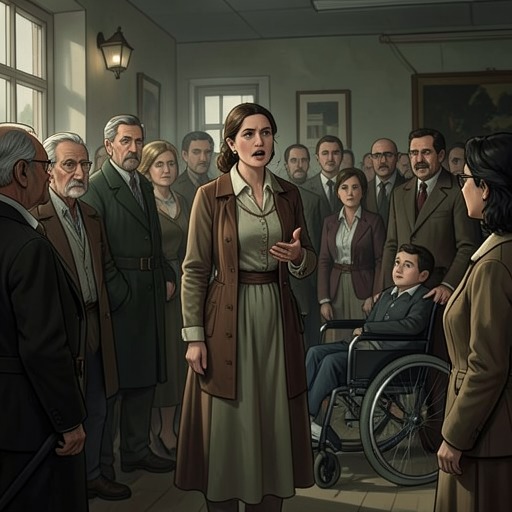
The Black family signs the attorney-retainer agreement
The RainmakerThe Black family signs the attorney-retainer agreement after Rudy Baylor brings the document to their home at the direction of Barry X. Lancaster. The task is more than a formality: all three family members must agree to representation, and Donny Ray Black is an adult whose signature is required. With Buddy Black unwilling to come inside, the contract is carried out to his car. Its eventual return, marked by an illegible signature and the other two signatures, formally binds the family and the firm as they prepare to sue Great Benefit Life Insurance Company.
Why the Signatures Matter
Barry gives Rudy a thin file containing the two-page contract and emphasizes that it must be signed immediately. He explains that Dot Black, Buddy, and Donny Ray must all sign before the firm can file suit. The urgency places Rudy in direct contact with the family and with the client whose illness he has been trying to postpone facing.
The agreement sets out the basic terms of representation: the firm will handle the case and its expenses, and will receive one-third of any recovery. Dot questions why such a short arrangement requires two pages of small print. Rudy describes it as standard language, but the exchange makes clear that the document is not merely paperwork to the family; it defines the financial terms on which they will entrust their claim to the firm.
A Signing at the Black Home
Rudy initially hopes to avoid gathering the family together. He anticipates the difficulty of bringing Buddy inside from his car and of meeting Donny Ray, whose condition he has not yet faced in person. Instead, he calls Dot from a pay phone and stresses that every signature is needed. When Rudy arrives, Buddy remains outside in the car, and Dot explains that she cannot get him to come in.
Dot brings Donny Ray into the kitchen. He is extremely thin and weak, and she supports him as he settles into a chair. Their meeting gives the legal task its human scale: Donny Ray knows that Rudy is suing the insurer and asks whether his father is coming inside. When Dot says Buddy will not, Donny Ray tells her to take the contract out to him. His insistence turns the family’s practical obstacle into a decision to finish the signing despite it.
Dot walks the document across the yard to Buddy’s car. Donny Ray tells Rudy that the family has previously managed to obtain Buddy’s signature without bringing him inside, recalling an earlier occasion when a notary made a house call. The account explains why the errand is familiar, but also why securing Buddy’s cooperation is a recurring difficulty. This time Dot returns with the contract, its first page slightly torn and its second marked with a smudge. Buddy’s signature is difficult to read, but it is there.
Donny Ray’s Stakes
While Dot is outside, Donny Ray explains the medical and financial history behind the claim. His acute leukemia was detected early enough to be treated, and he had an identical twin whose bone marrow was a match. The transplant could have saved his life, but the family could not afford it after Great Benefit failed to provide the insurance coverage they needed. Donny Ray says that his prospects have since become far worse, contrasting his current condition with the chance of recovery he believes treatment would once have offered.
His account changes the meaning of the contract signing. The agreement is not a distant legal maneuver undertaken solely by Rudy; Donny Ray is present, understands what the lawsuit is about, and wants it pursued. He also asks Rudy to use any recovery to care for his parents, who have had a hard life. His request places the family’s future inside the same document that specifies the firm’s fee.
From Agreement to Litigation
After Dot returns with Buddy’s signature, she and Donny Ray sign as well. The completed retainer allows the firm to proceed with the suit; Rudy later describes the agreement as a prerequisite to filing. The signing therefore marks a transition from discussion and preparation to formal legal action, while making all three Blacks clients rather than leaving the claim dependent on an informal understanding.
The later trial gives the agreement’s purpose its full context. Dot testifies about the family’s efforts to find treatment and reads Great Benefit’s denial letters to the jury. Donny Ray’s recorded deposition is also played in court, bringing his account of the illness and the denied transplant into the case. Rudy’s representation develops into a challenge to the insurer’s claim-handling practices, but the foundation for that courtroom effort is the modest kitchen-table transaction: a two-page contract, three signatures, and Dot’s trip to Buddy’s car.